Essay
WHEN DID THIS BECOME OK ESSAY
WHEN DID THIS BECOME OK?
An Artist Declaration by Don Vante (Big Blind)
I want to start with the question, because the question is the collection. WHEN DID THIS BECOME OK? is not a title I chose to provoke. It is a title I chose because I asked myself that exact sentence, out loud, alone in my studio, at some point during the third week of this body of work, and I did not have an answer. I still do not. That is the piece. Twelve paintings that do not resolve the question, made in a month I did not plan to survive creatively, let alone produce anything worth showing.
I need to be precise about what this collection is and what it is not, because precision is the only thing I trust right now.
This is not a breakup show. I will not stand in front of these twelve canvases and narrate a relationship for you. That is not the work I do, and grief that gets performed stops being grief and starts being content. What I will tell you, plainly, is that this collection was made in the direct aftermath of a breakup, and that the discomfort of that period is the material condition under which every one of these pieces exists. I am not hiding that. I am also not going to let it become the subject. The subject is what I did with it.
The Discipline I Left Behind, For a Month
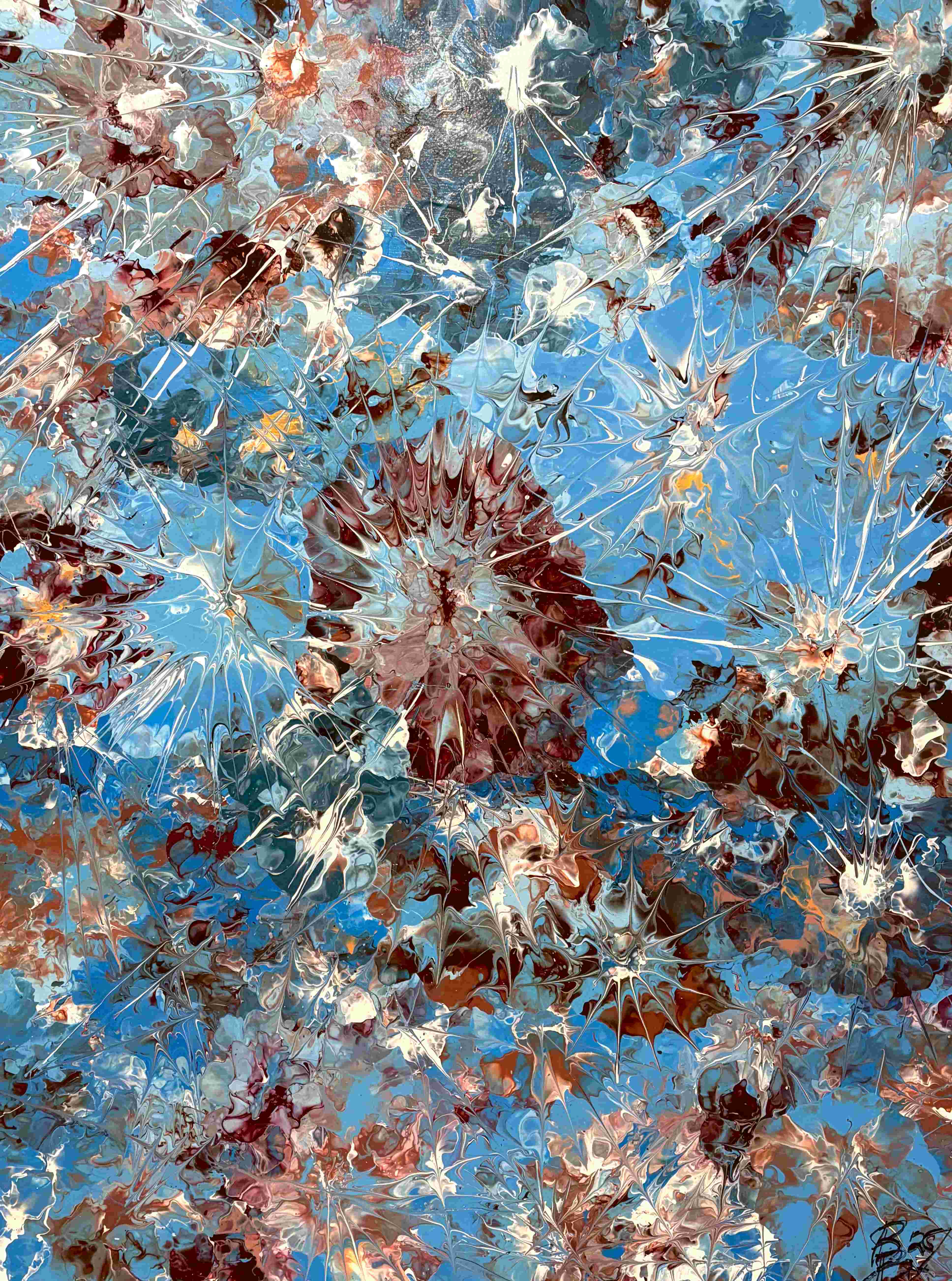
Anyone who has followed my practice knows somatic abstraction as my language. I retard the paint, soft body cut down through heavy body acrylic, thinned and extended with Floetrol and distilled water until it holds a very specific viscosity, thin enough to travel, thick enough to remember its own edges. Then I move it with breath. No straws, no compressors, no tools between my body and the canvas. I control the branching, the vein like tendrils, the pooling and thinning, entirely through how hard and how long I blow. It is a discipline of control through restraint. Every piece I have made in that language has been an exercise in how much I can shape an outcome while giving up the brush, giving up the hand, giving up the most direct form of authorship a painter has. I trade the hand for the lung. That trade has defined my work for years, and it still does. It is not gone. It is on pause for these twelve canvases, and the pause is deliberate.
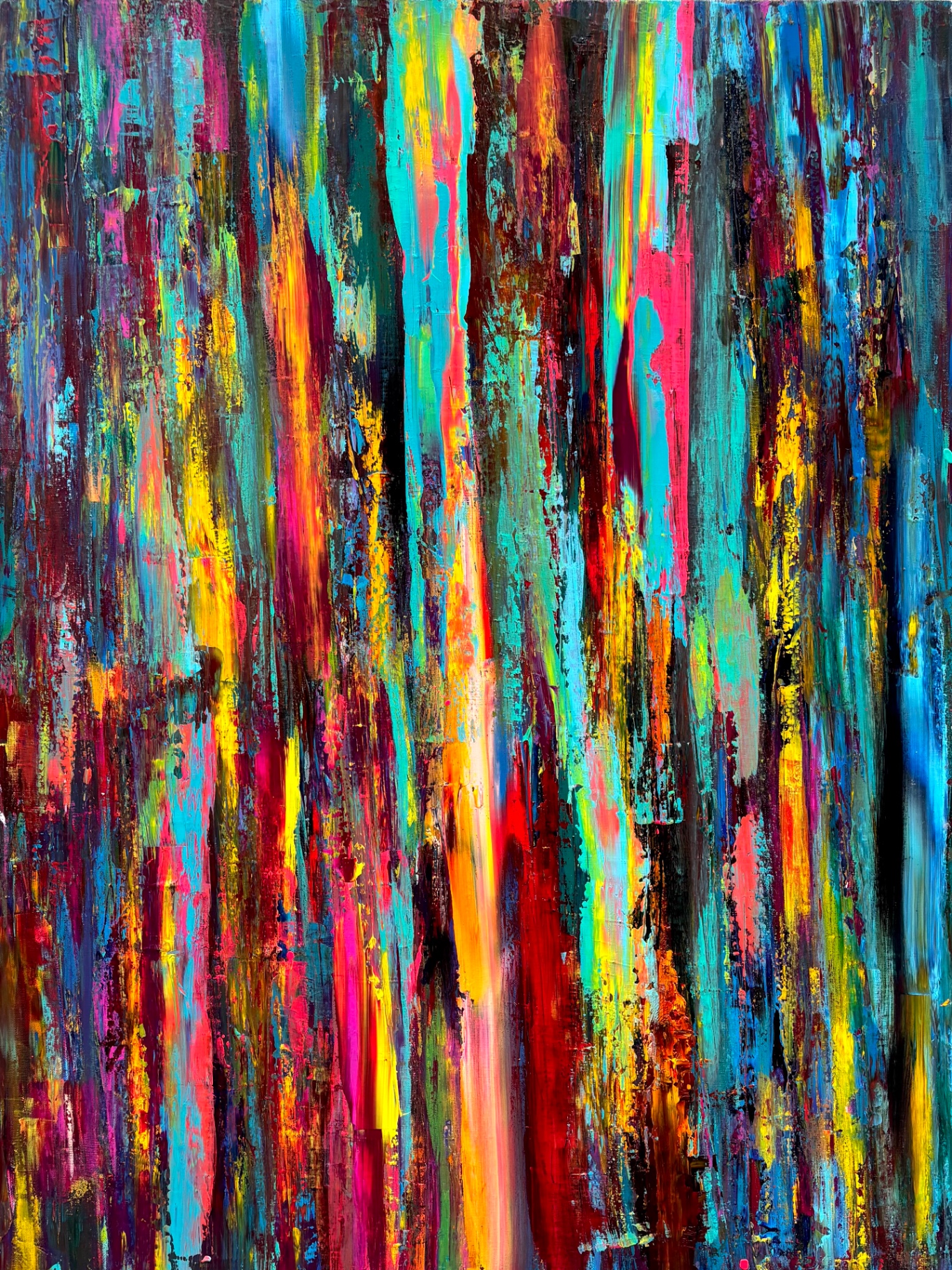
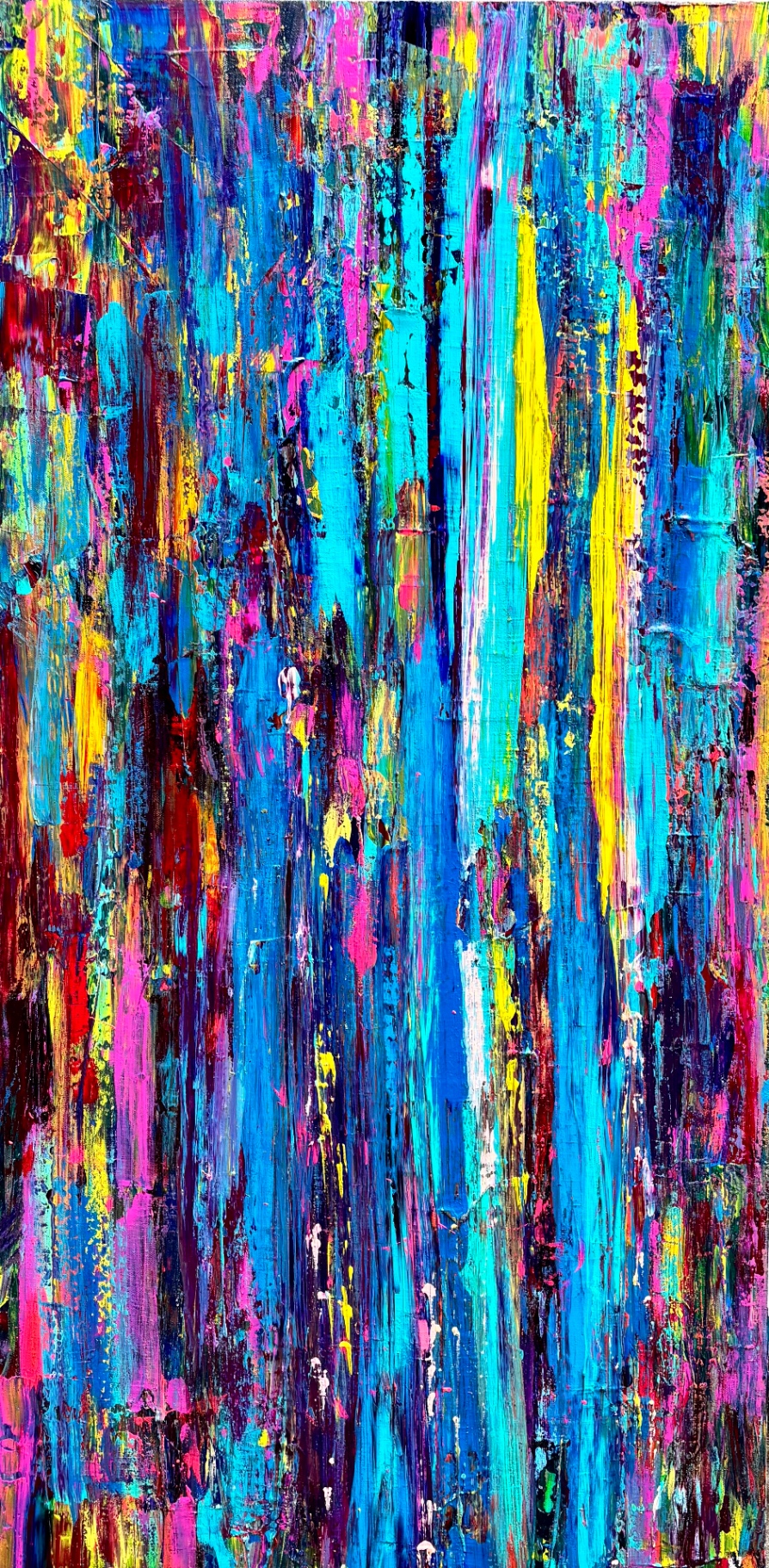
WHEN DID THIS BECOME OK? does not use breath. It could not. Breath control requires a body that is regulated enough to control something. I was not regulated. I was not capable of the patience that somatic abstraction demands: the seated, watching, waiting posture required to guide a bloom of pigment across a wet field an inch at a time. So instead of forcing the discipline onto a state that could not hold it, I let the state dictate a different discipline. Heavy body acrylic and oil, straight, mostly unthinned, worked directly onto canvas by hand and by tool, twelve pieces built around one central experiment: value and consistency in composition, and nothing else. No breath. No lungs. No Floetrol softening the material into something that moves easy. Just weight, straight from the tube, straight from the hand, and the question of how dark, how light, how thick, how thin a single composition could hold before it stopped being a composition and started being wreckage.
I want to be honest about why I made that choice instead of forcing myself back into the somatic practice out of loyalty to my own signature. It would have been easier, professionally, to keep working in the language people already recognize as mine. My agent would have preferred it. The market prefers continuity. But somatic abstraction, for me, is a controlled surrender. I let go of the brush, but I never let go of my composure. I could not access composure this month. What I could access was resistance. Heavy body paint does not float. It does not bloom. It fights you. It holds the mark of the hand that pushed it and does not forgive a hesitant pass. That resistance was the only honest material I had. So this collection is built entirely from paint that argues back.
The Month
Twelve pieces in roughly thirty days. I am not going to romanticize that pace as some kind of manic genius sprint, because it was not inspired, it was necessary. I needed somewhere to put the hours I was not sleeping. Painting became the only room in my life where the discomfort had a job to do instead of just sitting in my chest doing nothing. Each canvas in this collection was approached as a distinct experiment in value and consistency: how a single palette could shift from near black density to a scraped thin, almost translucent pass of the same color, and what that shift does to a composition that has no soft, breath guided transitions to lean on. Without the branching tendrils of somatic work, every value change had to be earned through the hand directly: layering, scraping back, building up heavy passages next to thin ones, letting some sections sit raw and unresolved against sections that are worked to a dense, almost sculptural thickness.
That is the technical spine of the collection, and I want it understood as technical, not just emotional. I did not simply "paint my feelings." I set myself a formal problem, how far can value and consistency carry a composition without the tool I usually rely on, and I solved that problem twelve different ways under conditions that made solving anything difficult.
The discomfort did not excuse the work from rigor. If anything it demanded more of it, because I had nothing else to hide behind. No breath control to fall back on if a passage did not work. No thinned pigment to bail me out with an accidental bloom that reads as intentional. Just my hand, heavy paint, and the discipline of finishing what I started even when I did not want to be in the room anymore.
Color as Citation, Even Here
My work has always treated palette as citation, a deliberate nod to specific painters, movements, periods, a conversation with art history rather than an arbitrary color choice. That practice did not disappear here either, though it operates more starkly. Where my somatic work often cites lush, Deco adjacent palettes built for atmosphere and glow, this collection pulls from harder references: the flattened, almost bruised value ranges of certain postwar expressionists, the refusal of decorative color that shows up in work made under duress rather than work made for beauty. I am not going to pretend every citation was calculated in the moment. Some of it I only recognized after the fact, looking at what my hand had reached for without asking my head first. But the citation is there, and it matters, because it places this collection in a lineage of artists who painted through something rather than around it. I am not the first person to use a canvas as the only place discomfort was allowed to be loud. I do not intend to be the last.
Rejecting Obstruction, Dismissal, Objection
I keep coming back to three words when I try to explain how this collection got made at all: obstruction, dismissal, objection. Every one of these twelve pieces exists because I refused all three, and I want to explain what I mean by each, because they are not the same thing and I did not fight them the same way.
Obstruction is the practical kind. It is the version of resistance that shows up as circumstance: no energy, no sleep, a body that does not want to stand at an easel, a mind that keeps leaving the room mid stroke. Obstruction does not argue with you. It just makes the work harder to physically do. I rejected it by lowering the bar for what counted as a studio day. Some days the win was one section of one canvas. Some days it was mixing paint and not touching a brush at all. I stopped requiring myself to have a good day in order to have a working day. That distinction kept the month moving when nothing else would have.
Dismissal is quieter and meaner. It is internal. It is the voice that tells you the work you are making right now does not count, that it is just processing, just therapy, not real practice, and that you should wait until you are "better" to make anything worth showing. I have heard that voice before, and this month I heard it constantly, and I rejected it on principle. Waiting to be well before making the work assumes the work has nothing to offer while you are unwell. I do not believe that. I think some of the most honest formal decisions I have made as a painter came directly out of a period I was in no condition to romanticize. Dismissing the work because of the condition it was made in would have meant dismissing the work itself, and I was not willing to do that to twelve finished canvases that held up when I looked at them clean, sober, and rested weeks later.
Objection is external, and it is the one I expect the most pushback on, honestly, including from people close to this practice. Objection is the voice, sometimes literal, sometimes just anticipated, that says a body of work made this fast, this raw, departing this hard from an established signature, in the direct wake of a breakup, is going to read as indulgent or unfinished or too soon. I understand the objection. I considered it seriously before I dismissed it. But an artist who only shows work once it has been fully metabolized, safely distant, run through enough time to be palatable, is an artist who has decided the audience's comfort matters more than the truth of the process. I did not make this collection for anyone's comfort, mine included. I made it because the alternative was making nothing, and making nothing was not something I was willing to accept from myself, no matter how legitimate the objection sounded in the moment.
Rejecting all three of these, obstruction, dismissal, objection, is not the same as ignoring reality. I am not claiming this month was fine. It was not. What I am claiming is that none of those three forces got the final say over whether the work happened. That refusal is the actual subject of this collection, more than the breakup itself. WHEN DID THIS BECOME OK? is not asking when it became okay to be in pain. It is asking when it became okay, expected, even, to let pain stop you from working. I do not think it ever was okay, for me. I think I just needed twelve canvases to prove that to myself again.
Pain as Tool, Not Identity
I want to be careful here, because there is a difference between using pain as a tool and building an identity around being someone who is always in pain, and I do not want this declaration mistaken for the second thing. Pain, in this collection, functioned the way any other material constraint functions in my practice, as a set of limits I worked inside of, the same way a fixed palette or a specific canvas size sets limits. I did not chase the pain to keep the work going. I used what was already present because it was present, and because avoiding it would have meant avoiding the only honest starting point I had that month. Once the collection was finished, the pain did not disappear, but its job was done. It had been metabolized into value ranges, into paint consistency, into twelve finished compositions that now exist independently of the state that produced them. That is what tools are for. You pick them up, you use them for the task in front of you, and you put them down.
I continue to believe that discomfort, handled with rigor rather than indulgence, is one of the more honest engines available to a working artist. I do not think every painting needs to come from a wound. Most of my work does not. But I am not interested in pretending this collection came from somewhere calmer than it did, either, because that pretending would cost the work its clarity. These twelve pieces know exactly what they are.
The Twelve
I am not going to walk through each canvas individually here, that belongs to the work on the wall, not to this declaration. But I will say that the sequence matters. Viewed in the order they were made, the twelve pieces track a shift that I did not plan but noticed after the fact: the earliest canvases in the collection are the heaviest, the darkest, the most resistant to light, built from thick, almost stubborn passages of paint that barely thin out anywhere across the surface. Moving through the month, the later pieces start letting more value range in, not lightness as resolution, not a tidy arc from dark to light, but more contrast, more negotiation between dense and thin, more evidence of a hand that was starting to have some range back. I did not engineer that progression. I only saw it once all twelve were finished and standing next to each other. I am including it here because I think it is the most honest evidence in the whole collection that something was actually moving during that month, even when it did not feel like movement from inside it.
Why This Departure Belongs in My Practice, Not Outside It
I anticipate the question of whether this collection sits apart from my larger body of work, given how directly it departs from somatic abstraction. My answer is no, and I want to be direct about why. My practice has never been about a single technique. It has been about using the body, breath, hand, whatever the state of that body allows, as the actual instrument of the painting, and being honest about what that instrument can and cannot do at a given time. Somatic abstraction is what my body does when it is regulated enough to control its own exhale with precision. This collection is what the same body does when regulation is not available and the hand has to do the work the lungs usually do. Both are somatic. Both are direct records of a body making decisions on canvas. The technique changed because the body changed. That continuity, body as instrument, whatever state the body is in, is the actual discipline underneath everything I make, and WHEN DID THIS BECOME OK? is a rigorous example of that discipline under conditions I did not choose.
Closing
I do not have a tidy answer to the question in the title, and I am not going to manufacture one for the sake of a clean ending to this declaration. What I have is twelve finished canvases that exist because I refused to let obstruction, dismissal, or objection have the final word on whether they got made. I have a month I do not fully remember clearly, and a body of work I remember with total clarity, because the work is what survived the month intact.
Twenty five percent of the profits from this collection, as with all of my work, go directly to dog rescue organizations. That commitment does not pause for hard months either. If anything, this collection is proof that the commitments I have made to this practice, to the discipline of finishing, to the citation of the artists before me, to the causes this work supports beyond the gallery wall, are strong enough to hold even when I am not at my strongest. That, more than any single canvas in this collection, is the declaration.
Don Vante
Share this essay
Instagram does not accept web links directly, so the caption and link are copied for you to paste into your story or post.
Continue looking